Residential Epoxy Flooring in Charleston, SC
Coastal-rated epoxy & polyaspartic floors for basements, kitchens, sunrooms & living spaces. Moisture-tested. Won’t peel or yellow.
A residential epoxy flooring system can turn a stained, dusty concrete slab into the best-looking, easiest-to-clean surface in your home — a seamless, grout-free floor that resists moisture, hides imperfections, and lasts for decades. But in the Charleston area, the result depends almost entirely on how the floor is prepped and which system is used. We install residential epoxy and polyaspartic floors built for the Lowcountry’s humidity and coastal slabs, in living spaces throughout your home — so the floor you pay for is still the floor you have in fifteen years.
Looking for residential epoxy flooring near you? We coat home floors throughout Charleston, Mount Pleasant, Summerville, Daniel Island, West Ashley, and the surrounding tri-county area.
Epoxy Flooring for Every Room in Your Charleston Home
Epoxy started in commercial and industrial spaces, but it’s now one of the most versatile flooring choices for a home — and it works far beyond the garage. Because it’s a coating that bonds to concrete rather than a material you lay on top, it creates a seamless, sealed surface that’s uniquely suited to the specific demands of each room.
Basements
Charleston’s humidity makes basements and ground-floor slabs prone to dampness, and that’s exactly where epoxy earns its keep. Applied over a properly prepped slab with a moisture barrier, epoxy acts as a seal against water vapor rising through the concrete — helping guard against the mold and mildew our climate loves to grow. The result is a brighter, cleaner, finished space that turns a damp storage area into a usable room, without a major renovation.
Kitchens
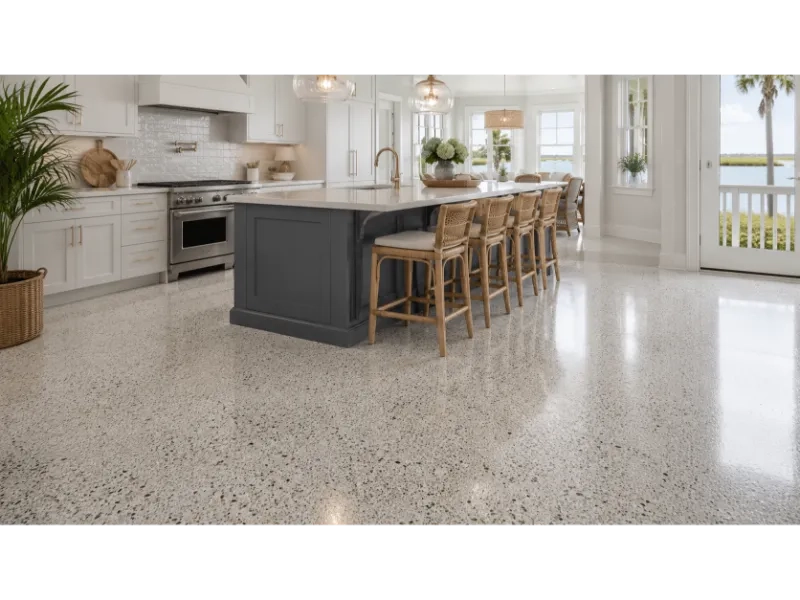
A kitchen floor takes constant spills, foot traffic, and cleaning — and epoxy handles all three. The seamless surface has no grout lines for grime to hide in, wipes clean with a mop, and resists stains from everyday kitchen use. With an anti-slip aggregate broadcast into the topcoat, it stays safe underfoot even when wet, and a decorative flake or metallic finish gives the look of high-end stone without the maintenance.
Living Spaces, Rec Rooms & Home Bars
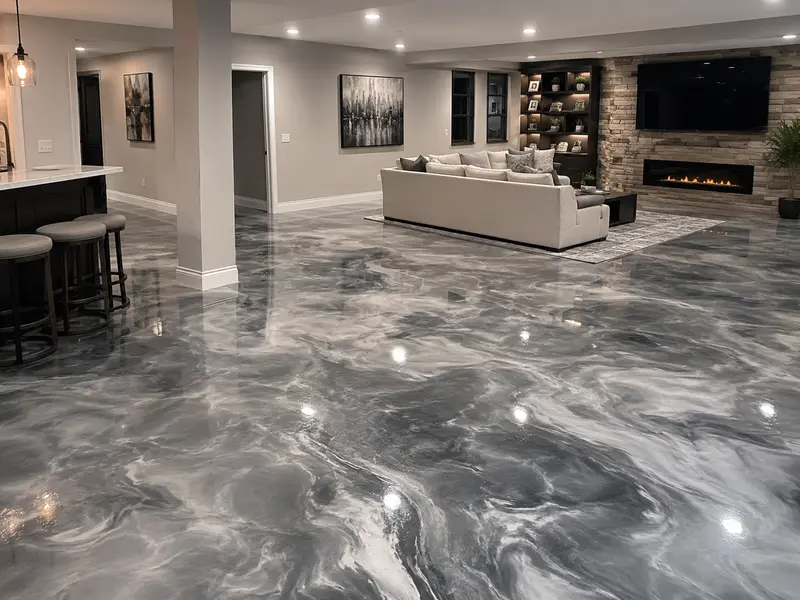
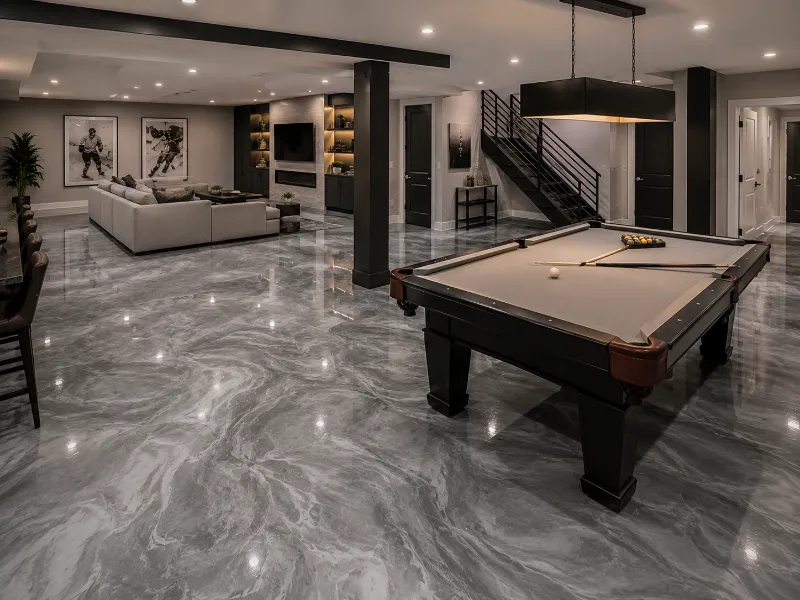
This is where epoxy stops being practical and starts being a design feature. Metallic epoxy creates a glossy, three-dimensional, marbled finish with real depth — ideal for finished basements, entertainment rooms, home bars, and open-concept living areas where you want a floor that’s a genuine focal point. Each one is one-of-a-kind, and lighting plays a huge role in how it reads, which is exactly why these belong in professional hands, not a weekend kit.
Sunrooms & Enclosed Porches
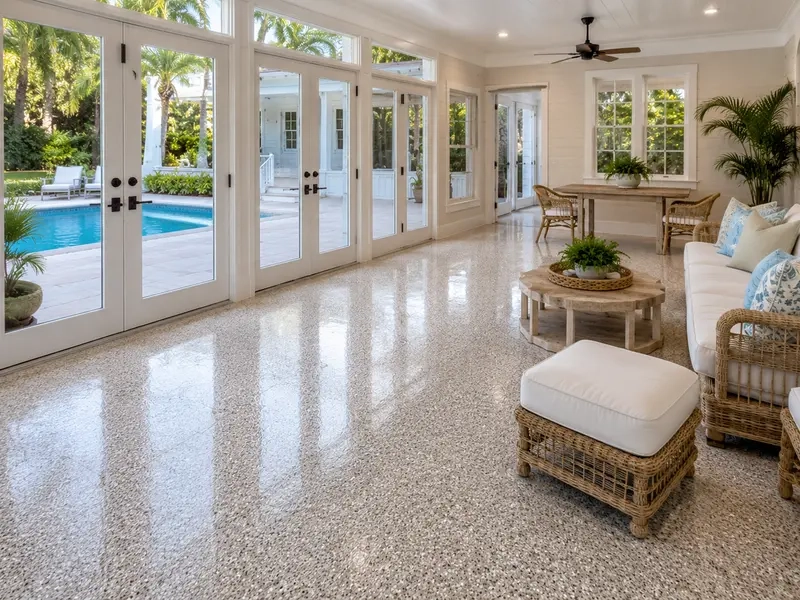
Sun-facing rooms need a UV-stable topcoat, or the floor ambers and yellows over time. We seal sunroom and porch floors with a UV-stable polyaspartic topcoat so the finish holds its color through Charleston’s 200+ sunny days a year, while staying cool and easy to clean.
Laundry & Utility Rooms
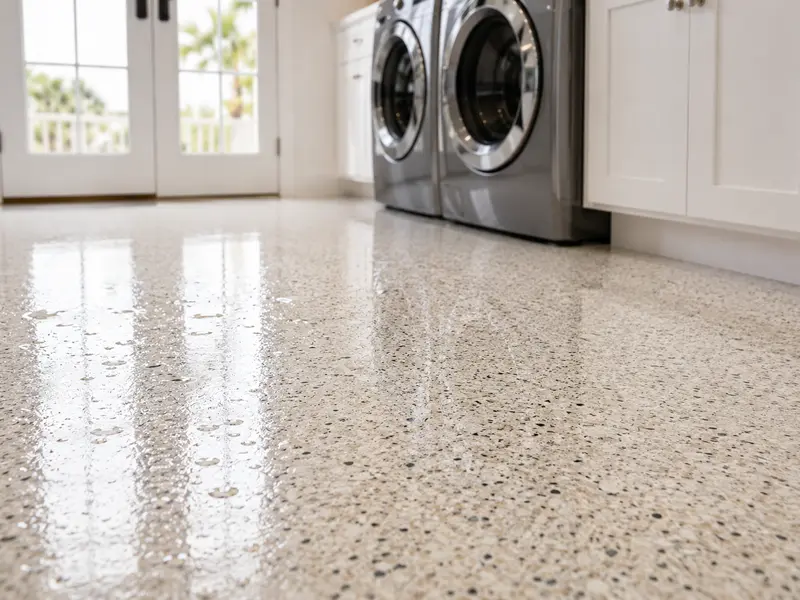
Waterproof, seamless, and low-maintenance — epoxy shrugs off detergent spills and standing water that would ruin other flooring, and minimizes the dust and debris that collect on bare concrete.
Note: We also coat garage floors — that’s a distinct service with its own considerations around hot tires and daily vehicle traffic. See our dedicated Garage Floor Coatings page →
Indoor Epoxy Is Different From a Garage — Here’s Why It Matters
Coating a living space inside an occupied home takes a different approach than coating a garage, and a contractor who treats them the same is cutting corners. Indoors, ventilation is limited, so a low-odor, low-VOC water-based epoxy system is often the right call — it produces minimal smell during installation and cures cleanly in a climate-controlled room. It also allows slight moisture movement, which helps on basement and lower-level slabs. Interior floors also demand a more precise finish, since living-space lighting shows every flaw a garage would hide. This is the kind of judgment that separates a real residential installer from someone applying a one-size-fits-all garage system to your kitchen.
Why Residential Epoxy Floors Fail — and How We Prevent It
Most of the epoxy horror stories homeowners read online trace back to a handful of avoidable mistakes. Roughly 80% of all epoxy floor failures come from improper surface preparation, not the product itself. Here’s what actually goes wrong inside a home, and how we prevent each one.
Peeling & Delamination
The problem: Sections lift off the slab, often starting at edges or seams. The Charleston cause: Porous concrete in a humid climate pushes moisture vapor up through the slab; trapped under a coating that wasn’t installed for it, the pressure breaks the bond. How we prevent it: We moisture-test every slab before quoting and diamond-grind the concrete for a true mechanical bond — no acid-etch shortcuts, and a moisture barrier where readings call for one.
Yellowing & Fading
The problem: A clear floor turns amber, especially in sun-facing rooms — a chemical breakdown cleaning can’t reverse. How we prevent it: A UV-stable polyaspartic topcoat over any sun-exposed floor — sunrooms, porches, rooms with big south-facing windows.
Slipperiness When Wet
The problem: A glossy floor gets slick in a kitchen, bathroom, or entryway. How we prevent it: A fine anti-slip aggregate broadcast into the topcoat wherever wet feet are a concern — traction without changing the look.
Cracking From Movement Or Temperature
The problem: Rigid coatings can crack as a slab moves or temperature swings. How we prevent it: A flexible polyaspartic topcoat over the epoxy base, so the system flexes with the slab instead of cracking apart.
What Sets a Lasting Floor Apart: Our Process
The difference between a floor that lasts three years and one that lasts twenty is almost always the prep. Our process on every residential job:
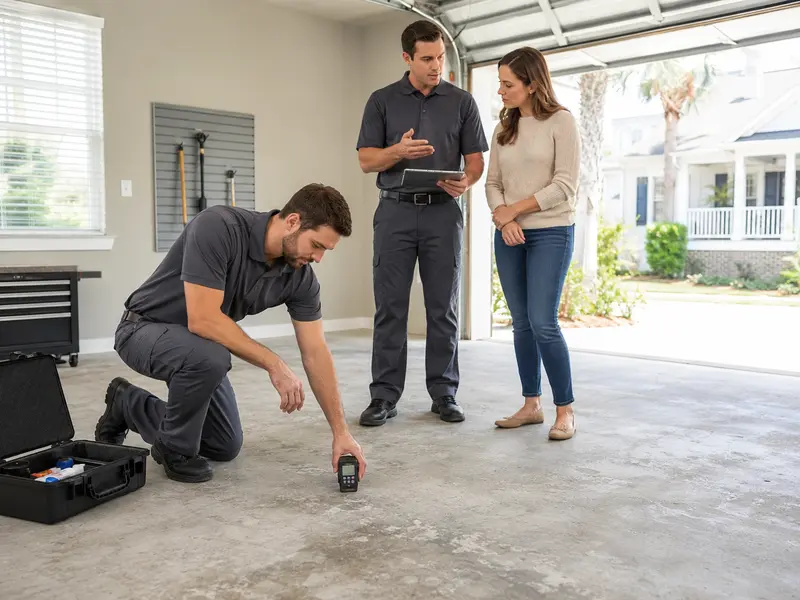
- Free on-site assessment + moisture test — we read your actual slab before recommending anything.
- Diamond grinding — mechanically profiling the concrete so the coating bonds at the surface level.
- Crack & joint repair — handled before any coating goes down.
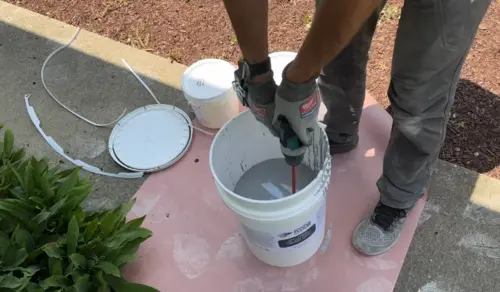
- Base coat — a durable epoxy (or a low-VOC, water-based system for occupied interiors) — locks into the profiled slab.
- Decorative layer — color flake, metallic pigment, or solid color, depending on the room and the look.
- UV-stable polyaspartic topcoat — the layer that delivers durability, UV resistance, and shine.
- Cure & walkthrough — most floors are walk-ready in hours.
Choosing Your Finish
Flake (Chip) Systems
The most popular home choice. Texture hides imperfections, adds slip resistance, and comes in dozens of color blends.
Metallic Epoxy
A glossy, one-of-a-kind, three-dimensional finish for living spaces, basements, and home bars.
Solid Color
Clean, uniform, and value-friendly for a modern minimal look.
Quartz Systems
Maximum slip resistance and durability for kitchens and high-traffic rooms.
What Residential Epoxy Flooring Costs in Charleston
Most professionally installed residential epoxy or polyaspartic floors run $5–$12 per square foot, depending on:
- Room size & layout — larger open rooms cost less per square foot; tight, cut-up spaces with lots of edges cost more.
- Slab condition — cracks, old coatings, or moisture issues add prep. Skipping prep is the #1 reason floors fail, so it’s not where to cut.
- Finish — solid color is the value end; flake is mid-range; metallic is premium.
A big-box DIY kit runs under $1/sq ft, but with a roughly 30% failure rate in two years — and a full re-grind required when it peels — the cheap number isn’t the real number.
Case Study: A Mount Pleasant Sunroom & Poolside Entry
A Mount Pleasant homeowner came to us with a sunroom that connected their pool area to the main living space — and a concrete floor that couldn’t keep up with it. Between wet feet from the pool, sand, kids, and pets, the bare slab had gone dull and lightly stained, with small surface cracks and dusting, making the room feel like an unfinished add-on. Tile felt too slippery and grout-heavy; vinyl wasn’t durable enough for a wet transition space. Their real worry: paying for a floor that would peel or discolor after a few humid Charleston summers.
We recommended a decorative flake system with a UV-stable polyaspartic topcoat — the right call for a bright, pool-adjacent room. After diamond-grinding the slab and repairing the cracks, we applied the epoxy base, broadcast a neutral flake blend matched to the home’s light walls and wood accents, then sealed it with the polyaspartic topcoat for UV stability, traction, and easy cleaning.
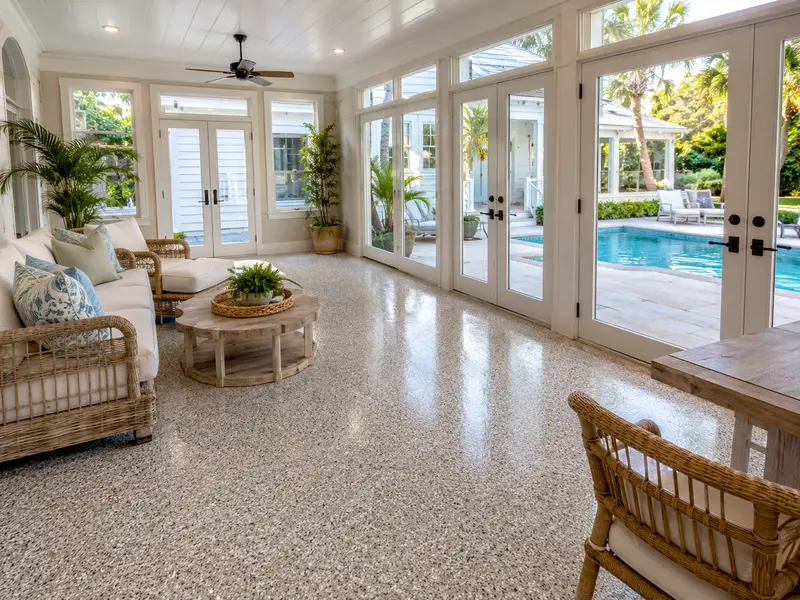
After: finished flake epoxy sunroom floor
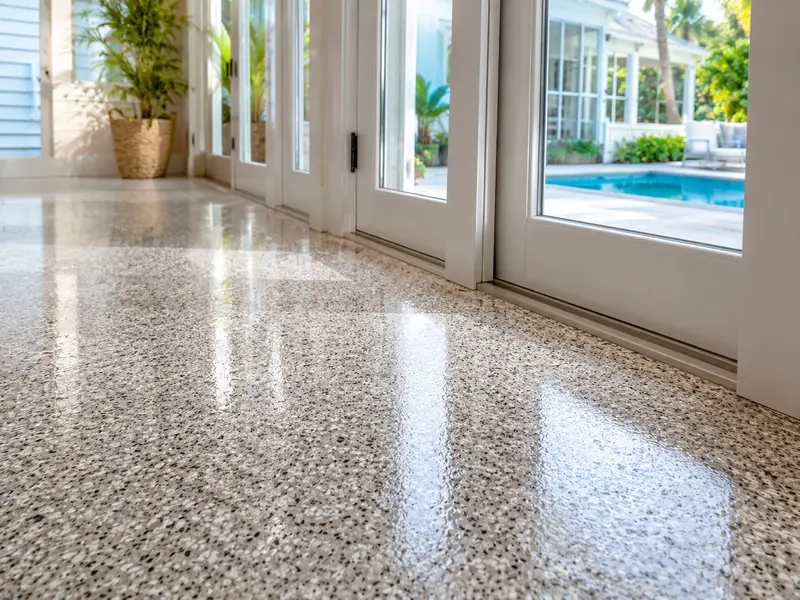
Finished sunroom floor, detail near the poolside entry
The result: a seamless, non-porous floor with no grout to scrub, better traction when wet, and a finished look that made the sunroom feel like part of the house instead of a leftover concrete space. In the homeowner’s words: “We wanted something nicer than plain concrete but tougher than regular indoor flooring — it handles wet feet from the pool much better than what we had.”
Serving Charleston & the Lowcountry
We install residential epoxy flooring across Mount Pleasant, Summerville, Daniel Island, West Ashley, James Island, Johns Island, North Charleston, Goose Creek, and the greater tri-county area — from historic peninsula homes to new builds in Nexton and Cane Bay.
How to Choose a Residential Epoxy Contractor
Not all installers prep or price the same way, and the difference shows up in how long the floor lasts. Before you hire anyone in Charleston, ask:
Do you diamond-grind, or just acid-etch?
Grinding is the professional standard; acid etching alone is a red flag.
Do you moisture-test the slab?
A real specialist tests before quoting.
Do you use a low-VOC system for interior rooms?
It matters in an occupied home.
What topcoat do you use?
Polyaspartic or urethane signals a quality system.
Is the warranty backed by the manufacturer or just the installer?
An installer-only warranty disappears if the company does.
A contractor who answers these clearly is worth trusting. One who gets vague about prep is the bigger risk than the price tag.
Once your floor is installed, keeping it looking that way takes almost nothing — regular sweeping, occasional mopping, and avoiding harsh chemical cleaners. (See our full guide on caring for your epoxy floor.)
Frequently Asked Questions
Answers to the top questions Charleston homeowners ask about residential epoxy flooring
Can you install epoxy flooring inside a house, not just a garage?
Yes — epoxy works throughout the home: basements, kitchens, living spaces, sunrooms, laundry rooms, and more. Interior installations use a different approach than garages, often a low-odor, low-VOC water-based system suited to occupied, climate-controlled rooms, with a finish precise enough for living-space lighting.
Is epoxy flooring good for basements in Charleston?
It’s one of the best basement flooring options here. Charleston’s humidity makes basement slabs prone to dampness, and epoxy — applied over proper prep with a moisture barrier — seals against rising water vapor, helping prevent mold and mildew while turning a damp space into a usable, finished room.
Is epoxy flooring slippery in a kitchen or bathroom?
It can be when wet, but we broadcast a fine anti-slip aggregate into the topcoat for kitchens, bathrooms, and entryways, so the floor keeps traction even when damp — without changing its appearance.
How long does residential epoxy flooring last?
A professionally installed residential epoxy floor typically lasts 15–20 years or more. DIY kits often fail within 1–3 years. Lifespan comes down to surface prep and system quality far more than the brand.
Will an interior epoxy floor smell during installation?
Traditional epoxy can be strong-smelling, which is why for occupied interiors we often use a low-VOC water-based system that produces minimal odor and cures cleanly indoors — much better suited to a lived-in home than a standard garage system.
Does epoxy flooring add value to my home?
It can. A seamless, durable, low-maintenance floor that finishes a basement or upgrades a kitchen adds usable, attractive space — and buyers recognize the difference between bare or damaged concrete and a professionally finished floor.
Will my epoxy floor turn yellow?
Standard epoxy yellows under UV, which is why we seal any sun-exposed room — sunrooms, porches, rooms with large windows — with a UV-stable polyaspartic topcoat that holds its color.
Ready for a Floor That Lasts?
Tell us about your space — the room, the square footage, the slab’s condition, and the look you’re after — and we’ll come out, moisture-test your concrete, and give you an honest, written quote. No pressure, no vague “starts at” pricing.
Serving Charleston, Mount Pleasant, Summerville, West Ashley, Daniel Island, North Charleston & the greater Lowcountry.