Metallic Epoxy Flooring in Charleston, SC
Custom marble and 3D metallic floors for Charleston homes and businesses — poured, seamless, and never the same twice.
What Metallic Epoxy Flooring Actually Is
Metallic epoxy is a multi-layer coating system, not a single product. A primer bonds to the prepared concrete, a pigmented epoxy base coat provides depth and build, metallic powders suspended in clear resin create the visual effect, and a polyaspartic or urethane topcoat seals and protects the finished surface.
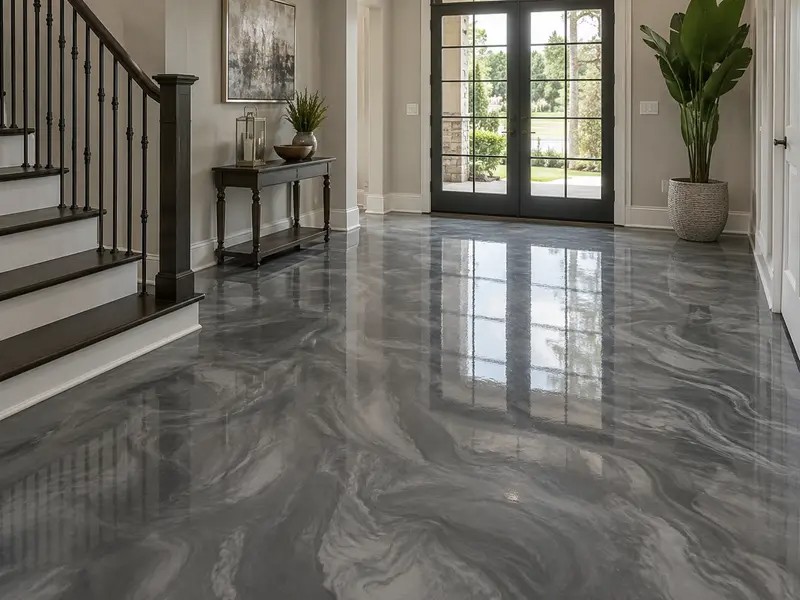
The effect comes from the pigment itself. Metallic powders are reflective and buoyant — they migrate through the wet resin as it levels, and installers direct that movement with rollers, brushes, air, and solvent to create veining, cells, ripples, and depth. This is why metallic epoxy floor coating is described as one-of-a-kind and why the installer’s hand matters more here than on any other floor system. Two crews using identical materials in identical rooms will produce visibly different floors.
That variability is the appeal and the thing to understand before you commit. You are commissioning a finish, not ordering a product.
Where Metallic Epoxy Flooring Gives the Best Results
Metallic epoxy performs differently depending on the space it goes into, and four conditions determine whether you get the full effect or a compromised version of it.
Lighting
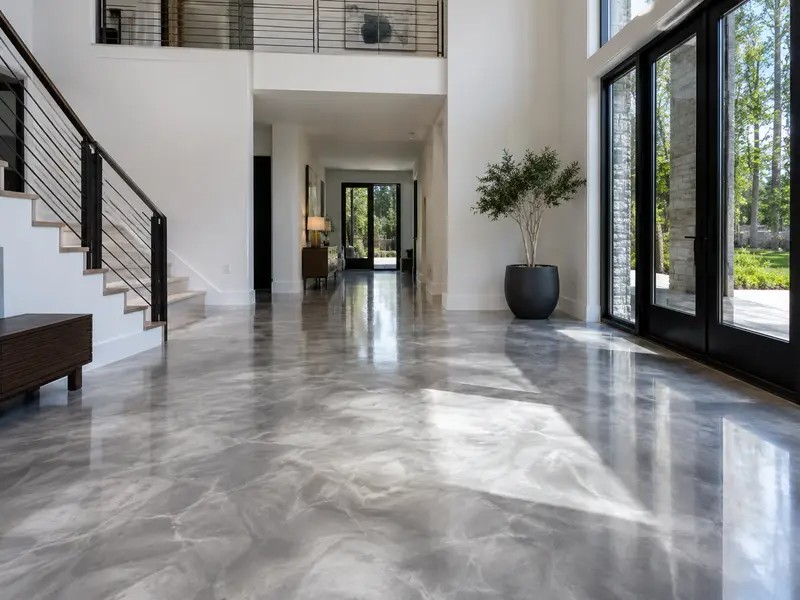
Metallic depends entirely on light to show its depth. Rooms with directional light — recessed ceiling fixtures, large windows, wall washers — produce dramatic movement across the surface. Flat, evenly diffused overhead lighting mutes the effect considerably.
Sightlines and Viewing Distance
The pattern reads best when you can see a large uninterrupted area at once. Open floor plans, entryways, and rooms viewed from a stair or landing show metallic at its best. Small rooms broken up by cabinetry hide most of the pattern you paid for.
Traffic Type
Metallic handles foot traffic well. It handles grit, dragged furniture, and rolling loads less well than a textured system. Spaces with clean, moderate foot traffic hold their finish longest.
Slab Condition
A high-gloss surface amplifies whatever is underneath it. Undulations, patch lines, and old coating ghosts stay visible under metallic. Slabs needing correction can still take a metallic floor, but the prep cost is real.
Where metallic is usually the wrong call: spaces with heavy abrasion, rolling equipment, or vehicle traffic, and wet areas without anti-slip aggregate added to the topcoat. If that describes your space, we will say so — see our garage floor coatings and commercial epoxy floor coating pages for the systems built for those conditions.
Marble Epoxy Floors: The Veined Finish Style
Marble epoxy floor is the term most people use for the veined, stone-look version of this system — and it is the same coating, applied with a different technique. Instead of a single metallic color creating cellular depth, a base color is laid down and one or two contrasting colors are drawn through it to produce veining that reads like polished marble or onyx.
Metallic marble epoxy flooring is the most requested style we quote in Charleston, and it suits the market for a specific reason: it gives the look of natural stone in a seamless, grout-free, non-porous surface. There are no joints to seal, no tile to crack, no grout lines collecting grit — and the visual weight sits well in both historic peninsula interiors and contemporary Mount Pleasant builds.
Common marble epoxy styles we install:
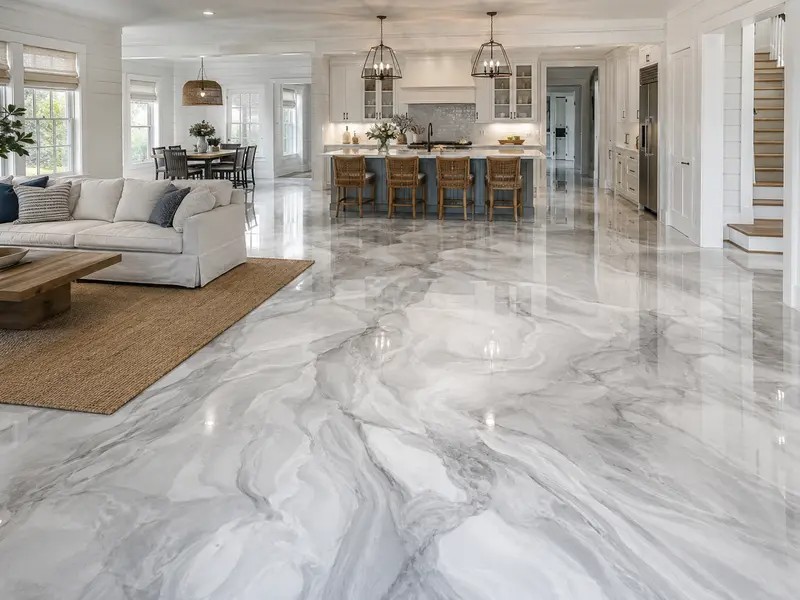
Classic White and Grey Veining
The closest to Carrara marble. Bright, neutral, works under almost any lighting.
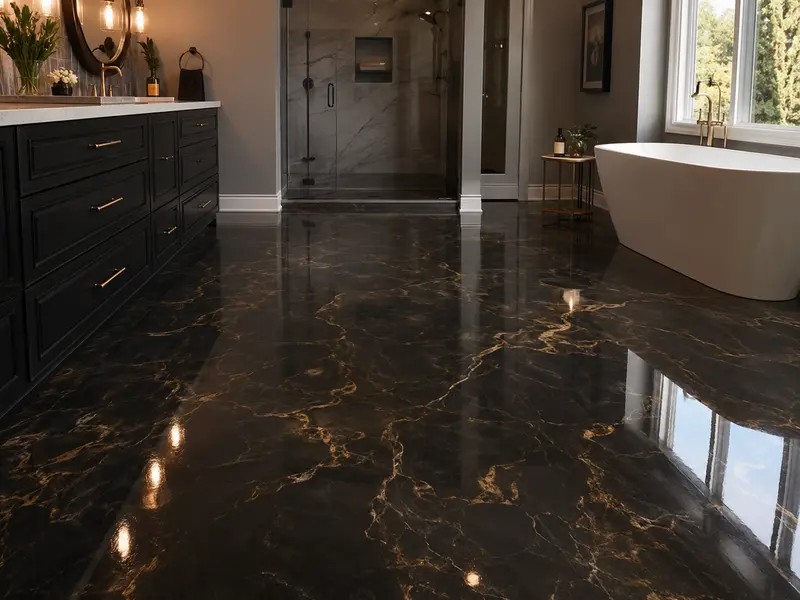
Black and Gold
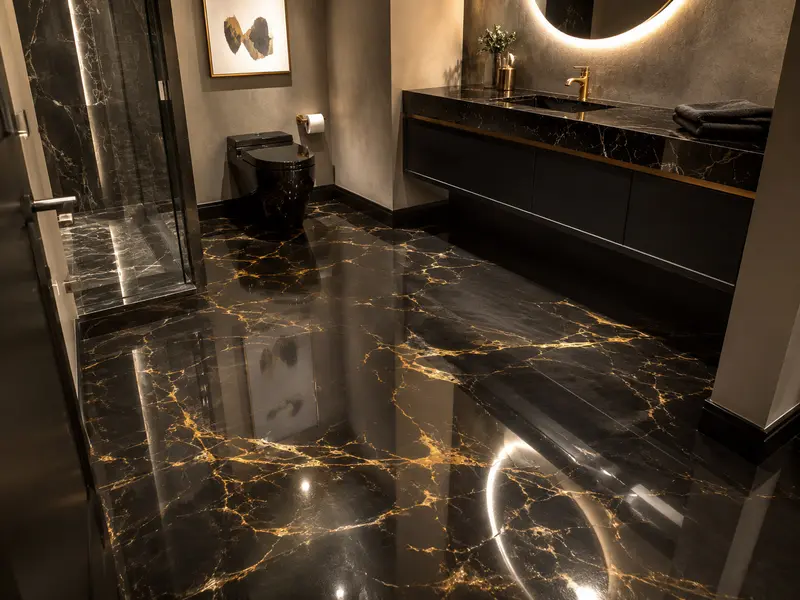
High contrast, dramatic, best in spaces with controlled lighting where the gloss can do its job.
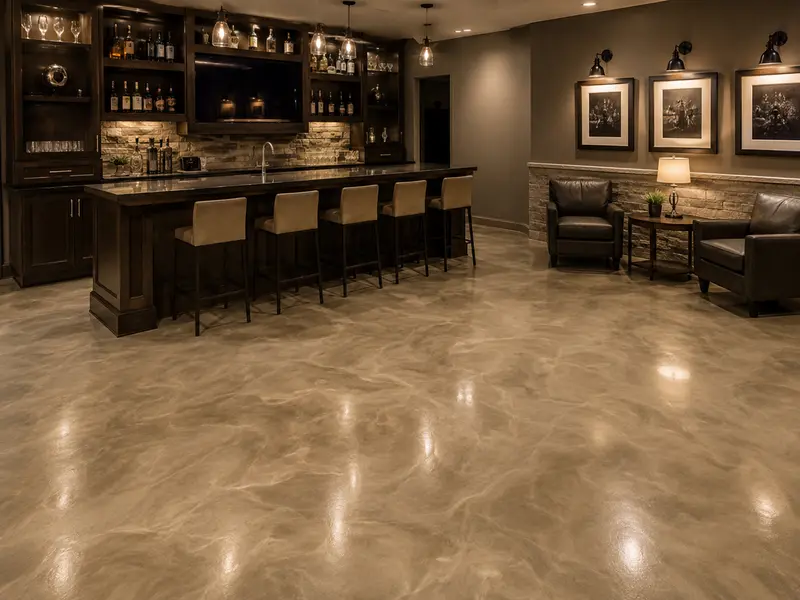
Sand, Taupe and Pearl
Soft, warm, low-contrast veining for interiors where the floor should complement rather than dominate.
Blue, teal and aqua flows — the coastal palette. Reads as water rather than stone, and it is the most-requested custom look in island and waterfront properties.
If you have a reference image of a marble or stone floor you like, bring it to the on-site visit. We can tell you honestly how close a metallic system will get to it in your specific space and lighting.
Metallic Epoxy Floor Colors and Design Options
Metallic epoxy floor colors are mixed rather than selected from a fixed chart, which means the range is effectively open — but the practical decision comes down to four things: base color, accent color, contrast level, and gloss level.
- Single-color metallic — one pigment creating cellular depth and shimmer. The most consistent, most predictable result, and the most forgiving in rooms with uneven natural light.
- Two-color blends — a base with a contrasting accent worked through it. This is where 3D metallic epoxy floor effects come from: the pigments settle at different rates and create genuine visual depth rather than a printed-looking pattern.
- Three-color custom — the most complex metallic epoxy floor design. Best in larger open areas where the pattern has room to develop and be seen.
- Gloss level — high gloss maximizes depth and reflection but shows dust and footprints more readily. A satin topcoat softens the effect and is more practical in a working space.
Two things worth knowing before you choose. First, metallic reads completely differently under warm artificial light than under north-facing daylight — a blend that looks slate grey in a showroom sample can read blue-green in a sunroom. Second, sample boards show color accurately but cannot show pattern scale; a swirl that looks tight on a 12-inch board spreads out considerably across 400 square feet.
We bring samples to the site and view them in your actual lighting before anything is ordered.
Metallic Epoxy Floor Cost in Charleston
Metallic epoxy floor cost per square foot in Charleston runs approximately $6 to $12 installed, depending on the system and the condition of your slab. That puts it above flake and solid-color coatings and well below natural stone or high-end tile. Here is what sits inside that range and what moves a quote up or down.
What the Price Includes
Full surface preparation, primer, pigmented base coat, metallic layer, and a protective topcoat. A metallic epoxy flooring price that does not clearly itemize these stages is not a comparable quote.
What Moves the Number
- Square footage and layout — larger open areas cost less per square foot than small rooms cut up by cabinetry, columns, and doorways, where edge work drives labor. Small jobs also carry setup minimums, so a compact room often prices higher per square foot than a large one.
- Slab condition — cracks, spalling, old adhesive, or a previous failing coating all add preparation. Removing a failed coating before installing a new one is a separate line item, not an afterthought.
- Number of colors — single-color metallic sits toward the lower end of the range. Two-color blends land mid-range. Three-color custom work and complex veining sit at the top, and genuinely intricate designs can run above it.
- Topcoat specification — a standard epoxy clear coat is cheapest. A polyaspartic or urethane topcoat costs more and is the correct specification for any space that gets real use. We quote the topcoat explicitly rather than burying it.
Approximate Charleston Figures
These are ballpark ranges to help you budget, not quotes. Every slab is different and the only accurate number comes after we have seen yours.
| Space | Approx. Size | Approximate Installed Cost |
|---|---|---|
| Entryway or powder room | 100–150 sq ft | around $900 – $1,800 |
| Home bar or media room | 300–400 sq ft | roughly $2,000 – $4,500 |
| Open living area | 600 sq ft | roughly $3,500 – $7,000 |
| Commercial showroom floor | 1,000+ sq ft | from around $6,000 upward |
You will see advertised prices in Charleston starting lower than these ranges. Those entry figures generally assume a sound slab, a single color, minimal preparation, and a basic clear coat. They are real numbers for the right job — they are just not what most floors end up costing once the slab has been tested and the topcoat specified properly. A quote materially below the ranges above usually means one of three things: acid etching instead of diamond grinding, a thinner build than specified, or a standard clear coat where a polyaspartic topcoat belongs. Any of those costs more to fix than the original saving.
We give you a written number after we have seen and tested the slab — not a phone estimate.
Metallic Epoxy vs Flake Epoxy: Which One Fits Your Space
The metallic epoxy vs flake epoxy decision comes down to whether the floor’s job is to look striking or to work hard. Both are professionally installed epoxy systems with similar lifespans when prepared correctly — they simply behave differently.
| Metallic Epoxy | Flake (Chip) Epoxy | |
|---|---|---|
| Appearance | Glossy, three-dimensional, marble or liquid effect | Textured, speckled, uniform |
| Consistency | Unique — every floor differs | Predictable and repeatable |
| Hides slab flaws | Amplifies them — prep must be excellent | Camouflages minor imperfections |
| Shows dust and marks | More visible on high gloss | Very forgiving |
| Slip resistance | Smooth unless aggregate is added | Naturally textured underfoot |
| Spot repair | Difficult to match | Straightforward to blend |
| Cost per sq ft | approx. $6 – $12 | approx. $5 – $9 |
| Best for | Display and living spaces | Working and high-traffic spaces |
The honest summary: metallic belongs where people look at the floor; flake belongs where people use it. If you are coating a space that takes vehicle traffic, dropped tools, or heavy rolling loads, our garage floor coatings page covers the systems built for that. For interior rooms across the home, our residential epoxy flooring page compares every finish by room. For business premises, see commercial epoxy floor coating.
Why Metallic Epoxy Floors Scratch — and How to Prevent It
The most common question we get from buyers comparing quotes is whether a metallic floor will scratch. It can, and anyone telling you otherwise is overselling — but the answer is better than most people expect.
The pattern in a metallic floor sits underneath the clear topcoat. That topcoat is the wear layer, and it is the only part that scratches. High gloss makes any mark more visible than it would be on a textured floor, which is why metallic gets the reputation. The artwork itself is protected.
The main cause is grit tracked in underfoot — sand and dirt acting like sandpaper under every step, which matters more in Charleston’s sandy soil than in most markets. Dragged furniture and abrasive cleaning pads account for most of the rest. Pet claws do far less damage than people assume.
Two things prevent almost all of it. The first is decided before your floor is ever poured: a polyaspartic or urethane topcoat is substantially more abrasion-resistant than a standard epoxy clear coat. It costs more, we quote it explicitly, and it is the single biggest factor in how your floor looks in five years. The second is simply stopping grit at the door with walk-off mats and using felt pads under furniture.
And if a floor does wear? The topcoat can be abraded and recoated across the full surface, restoring gloss without touching the pattern underneath. That is maintenance, not replacement.
How We Install a Metallic Epoxy Floor
- Assessment and moisture testing. We test the slab before quoting. Charleston concrete carries moisture, and a decorative system installed over an untested slab is a gamble — more on why coastal moisture drives coating failure here.
- Diamond grinding. Mechanical profiling, not acid etching. The gloss on a metallic floor magnifies everything underneath it, so preparation standards are higher here than on a textured system.
- Crack and defect repair. Filled and levelled before any coating goes down.
- Primer and pigmented base coat. The base color and build layer.
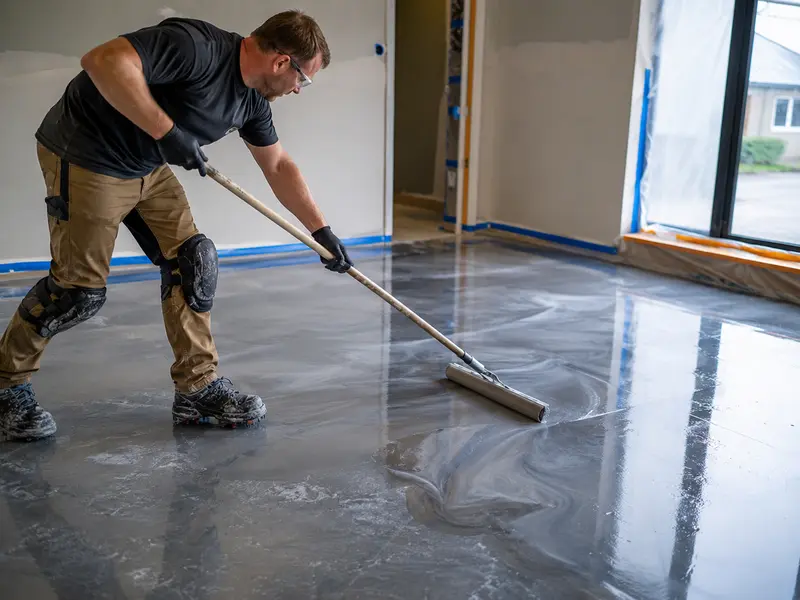
- Metallic application. Pigment suspended in clear resin, worked to create the pattern. This is the stage that cannot be rushed or repeated.
- Polyaspartic or urethane topcoat. Seals the pattern, adds abrasion resistance, and holds the gloss.
- Cure and walkthrough. Light foot traffic in about 24 hours, full use in roughly 72. We walk the floor with you before we leave.
Metallic Epoxy Flooring Near You in Charleston
If you have been searching for metallic epoxy floor installers near me, we install throughout Charleston, Mount Pleasant, Daniel Island, West Ashley, James Island, Johns Island, Summerville, North Charleston, and the barrier islands. Full service area and coverage details here.
Metallic is a specialist finish and we quote it as one — on-site, with samples, in your lighting, on your slab.
Frequently Asked Questions
Answers to the top questions Charleston homeowners and business owners ask about metallic epoxy flooring
What is metallic epoxy flooring?
Metallic epoxy flooring is a multi-layer coating system that combines pigmented epoxy with metallic powders suspended in clear resin, sealed under a protective topcoat. The powders move through the resin as it cures, producing marbled veining, cellular depth, and a high-gloss three-dimensional appearance. Every installation is unique because the pattern forms during application rather than being pre-printed.
How much does a metallic epoxy floor cost per square foot?
In Charleston, metallic epoxy floor costs run approximately $6 to $12 per square foot installed, covering preparation, primer, base coat, metallic layer, and topcoat. A 400 square foot room typically lands somewhere between $2,000 and $4,500. Slab condition, number of colors, room layout, and topcoat specification are the main variables, and small rooms price higher per square foot than large open areas.
What is the difference between metallic epoxy and regular epoxy?
Regular epoxy produces a uniform, single-color surface. Metallic epoxy adds reflective pigment powders that migrate during curing to create depth, veining, and movement. Metallic costs more, takes longer to install, requires more skill, and produces a decorative result rather than a purely functional one.
Is marble epoxy the same as metallic epoxy?
Yes. Marble epoxy floor describes the veined, stone-look style produced with the same metallic system — a base color with contrasting colors drawn through it to mimic natural marble. The materials are identical; only the application technique differs.
Can a metallic epoxy floor be repaired?
Localized repairs are difficult to make invisible, because every metallic floor has a pattern that cannot be exactly reproduced in a small patch. Minor surface scratches in the topcoat can often be polished, or the topcoat recoated across the full area. Significant damage usually calls for recoating the whole floor rather than spot-patching, which is one reason correct preparation and topcoat specification matter at installation.
How do you clean a metallic epoxy floor?
Sweep or dust-mop regularly, and damp-mop with warm water or a pH-neutral cleaner. Avoid soap-based products, which leave a film that dulls the gloss, and avoid abrasive pads or acidic cleaners. Wipe spills promptly. No waxing or sealing is required — the topcoat is the finish.
Will a metallic epoxy floor scratch?
The topcoat can scratch, and high gloss makes marks more visible than on a textured floor. Grit tracked in underfoot is the main cause, not pet claws. A polyaspartic or urethane topcoat resists abrasion far better than a standard epoxy clear coat, and walk-off mats plus felt pads on furniture prevent most damage. Because the pattern sits below the topcoat, a scratched surface can be recoated without disturbing the design.
Can metallic epoxy be installed over an existing epoxy floor?
Sometimes, but rarely without preparation. The existing coating must be sound, fully bonded, and mechanically abraded to accept a new layer. A failing, peeling, or unknown coating should be ground off entirely — installing over a compromised layer means the new floor fails when the old one does. We assess this during the site visit.
How is metallic epoxy applied?
After the slab is ground and primed, a pigmented base coat is laid down, then metallic pigment mixed into clear resin is poured and spread across it. The installer manipulates the wet material with rollers, brushes, air, and solvent to move the pigment into veins and cells. Once cured, a protective topcoat is applied over the finished pattern.
Is a metallic epoxy floor worth it?
For a space where appearance is the priority — an entry, a bar, a media room, a showroom — it delivers a look no other flooring system replicates, in a seamless, non-porous, easy-to-clean surface. For high-abrasion working spaces, a flake or quartz system generally gives better value. The right answer depends on the room, and we will tell you plainly if metallic is not the best fit for yours.
Ready to See What Your Floor Could Look Like?
Tell us the room, the square footage, and the look you have in mind. We will come out, test the slab, bring samples, show you how the colors read in your own light, and give you a written price with the full system specified.
No obligation, no vague “starts at” pricing, and an honest answer about whether metallic is the right system for your space.
Serving Charleston, Mount Pleasant, Summerville, West Ashley, James Island, Daniel Island, North Charleston, Kiawah and Seabrook Islands, and the greater Lowcountry.